Next Meeting
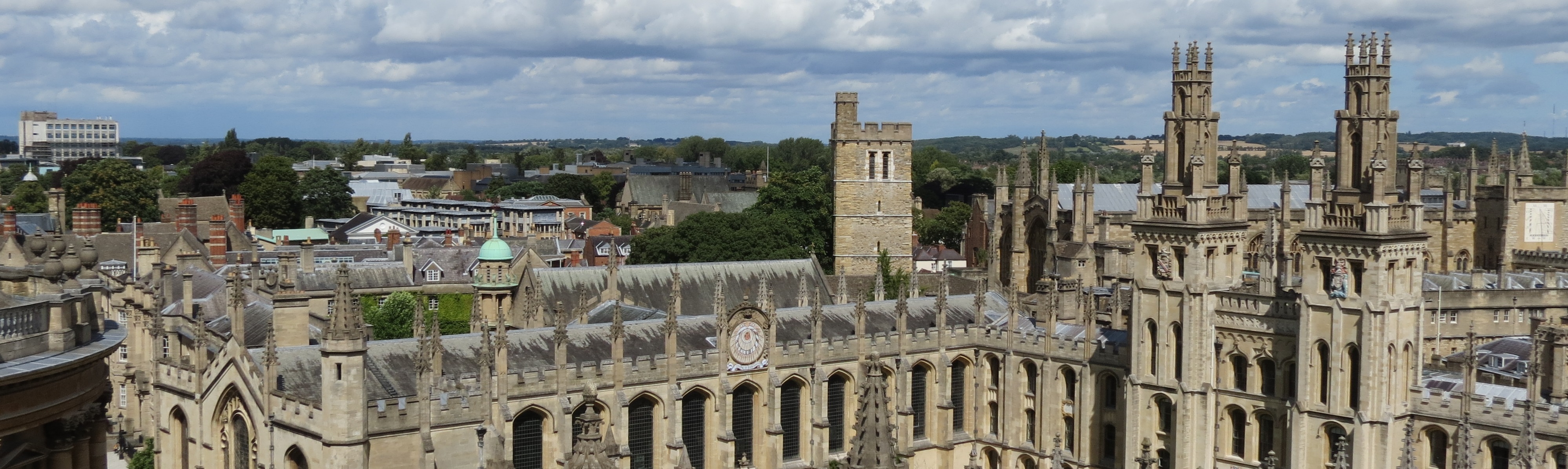
University of Oxford - Thursday 29th October 2026
The next meeting of the COW will take place at the University of Oxford on Thursday 29th October. The meeting will start at 1pm and finish at 5pm.
Speakers:- Alessio Cela (Cambridge)
- Anne-Sophie Kaloghiros (Brunel)
- Timothy Logvinenko (Cardiff)
For those who do not wish to attend the meeting in-person, we also plan to broadcast talks live using Microsoft Teams. Information about how to join the Teams meeting will be circulated to the COW mailing list the day before the meeting. If you would like to join the COW mailing list, instructions on how to do so may be found on the mailing lists page. If you would like to attend the meeting remotely but do not want to join the mailing list, please send an email to Alan Thompson (A.M.Thompson (at) lboro.ac.uk) requesting the meeting information.
Schedule
All talks will take place in the Mathematical Institute.
| Time | Room | Speaker | Title |
| 1:00pm | L4 | Alessio Cela | Brill–Noether existence and interpolation for maps to blow-ups of projective space |
| 2:00pm | Break in the Mathematical Institute Common Room | ||
| 3:00pm | L4 | Timothy Logvinenko | The Heisenberg algebra and Hochschild homology |
| 4:00pm | L3 | Anne-Sophie Kaloghiros | On K-moduli of prime Fano threefolds of genus 12 |
Funding and Travel Claims
The COW has some funding to cover travel expenses for UK-based PhD students and postdocs. The COW is currently funded by the Isaac Newton Institute and the Heilbronn Institute for Mathematical Research under the UKRI/EPSRC Additional Funding Programme for Mathematical Sciences (EPSRC EP/V521917/1) and by the London Mathematical Society under a scheme 3 grant.
To ensure that we can fund as many participants as possible, we ask that participants purchase "advance" or "off-peak" train tickets where practical, and non-travel expenses (e.g. accommodation, food) cannot be covered. For those under the age of 30, we also recommend looking into getting a railcard, which can offer substantial savings on the cost of train travel around the UK. Information about how to submit a claim is available on the COW homepage here.
Abstracts
- Alessio Cela (Cambridge) - Brill–Noether existence and interpolation for maps to blow-ups of projective space
- Brill–Noether theory studies when a general curve admits a map to projective space and whether the space of such maps is smooth of the expected dimension. The interpolation problem asks how freely these maps move, for example how many general points their images can be required to pass through. While Brill–Noether theory for projective space is classical, the interpolation problem was settled only recently by Larson and Vogt. I will present joint work with Carl Lian extending both questions to blow-ups of projective spaces. We prove a sharp existence theorem in arbitrary genus and determine interpolation in genus zero.
- Timothy Logvinenko (Cardiff) - The Heisenberg algebra and Hochschild homology
- In this talk, I will explain how for any noncommutative smooth and proper variety X we can construct three actions of the Heisenberg algebra on the total Hochschild homology of its symmetric quotient stacks [X^n/S_n]. One is defined algebraically using the orbifold decomposition of Hochschild homology. One decategorifies the 2-categorical Heisenberg action of arXiv:2105.13334. One is defined representation theoretically via explicit operators intrinsic to the symmetric quotient stacks. It turns out that these three actions coincide, and thus give alternative descriptions of one natural action. For ordinary commutative varities, we give a fourth, geometrical description by correspondences similar to those used by Grojnowski and Nakajima for the Hilbert schemes of points on surfaces.
- Anne-Sophie Kaloghiros (Brunel) - On K-moduli of prime Fano threefolds of genus 12
- Over the past decade, much progress has been made in understanding explicit K-stability of smooth Fano threefolds. We now know which of the 105 deformation families of smooth Fano 3-folds correspond to a non-empty K-moduli space and have a complete description of these K-moduli spaces in many cases. Current techniques however do not tell us much about K-moduli spaces of prime Fano threefolds. An especially interesting case is that of prime Fano threefolds of genus 12 (V22). While the general Fano of type V22 is K-stable, some strictly K-semistable examples are known. In this talk, I will describe the boundary of the K-moduli stack of Fano threefolds of type V22. This is based on joint work with Liu, Petracci and Zhao.




This page is maintained by Alan Thompson and was last updated on 16/10/26. Please email comments and corrections to A.M.Thompson (at) lboro.ac.uk.